Quick answer
I’m a travel planner with ADHD and dyslexia, and I’ve always been a planner. I plan in bursts rather than step by step, so I built my business around how brains like mine work: fewer choices, one decision at a time, and information that’s easy to take in, rather than long PDFs and a wall of options.
I’m a Travel Planner With ADHD
What the Travel Industry Gets Wrong About Brains Like Mine
People assume that running a travel planning business and having ADHD don’t go together. Planning is supposed to be the opposite of how my brain works, right?
Wrong. But it took me years to stop believing that myself.
I’m also dyslexic. I genuinely hate the struggle of reading. For a long time that made the “research everything yourself” side of travel planning miserable. What’s changed things for me is having systems in place now that can read documents out loud to me. That one shift has made a huge difference, and it’s part of why I think about information differently to most planners: if it’s hard for me to take in, I assume it’ll be hard for someone else too, and I build around that.
Here’s another thing people don’t expect: despite my ADHD, I’ve always been a planner. Always. If anything, it might be a bit of a trauma response but it’s also got me out of a fair few sticky situations over the years. Planning, for me, has never been the opposite of who I am. It’s part of how I’ve coped.
Flexibility, though, that was hard. Properly hard, until I had my son. He changed how I think about it completely.
Travel itself has been in me since I was young. And I’ve also worked in the travel industry myself, for a good stretch which gives me a different kind of insight into all of this. I’m not guessing at what the industry gets wrong. I’ve been inside it.
How I actually plan
Here’s the truth: when I plan my own trips, I don’t do it the “normal” way. There’s no calm Sunday afternoon where I sit down and work through it step by step. It bursts. Nothing for three days, then suddenly I’m booking a hotel at 04.00am because my brain has finally clicked into gear and I need to use it now before it switches off again. And it will be right when I need it to work with me not against me.
If I tried to force myself into the tidy, linear process the travel industry expects everyone to follow, I’d never book anything. I know, because I’ve tried. For years.
So I stopped trying to fit the system. I built my business around how my brain and a lot of my clients’ brains actually work.
The industry assumes everyone processes the same way
Walk into most travel planning conversations and you get a wall of options, a twelve-page PDF itinerary, and “let me know if you have any questions” like questions are the exception, not the rule.
For me, and for a lot of the families I work with, that’s not helpful. It’s a wall. The more choices you hand someone whose brain is already overloaded, the less likely anything gets booked at all. I know this because it’s happened to me, with my own holidays, more times than I’d like to admit.
What actually works is the opposite. Fewer choices. One decision at a time. Said plainly. Not because anyone can’t handle information, but because decision fatigue is real, and a 40-tab browser window has never once ended in a booking.
The industry assumes “flexible” means “easy”
I cannot tell you how often I’ve been told to “just stay flexible”, flexible dates, flexible plans, see how you feel on the day. For some people that’s freeing. For me, an unstructured day isn’t relaxing. It’s a question mark with no answer. And question marks are exhausting.
Structure isn’t the enemy of rest. The right amount of it, knowing what’s happening, having a plan B already sorted, is often what makes rest possible in the first place.
And here’s what I’ve come to think “flexible” really means when the travel industry says it: it’s not about you. It’s about revenue, and about who picks up the slack when things change. If a flight gets moved or a booking falls through, “just be flexible” often means someone else, usually the customer, absorbs the disruption, while the company makes the smallest possible effort to fix it.
What actually matters isn’t flexibility for its own sake. It’s clear communication. And that includes listening, really listening to what someone needs, not just telling them to adapt.
The industry assumes asking for help is a last resort
There’s a quiet shame in needing planning support, like it means you’ve failed at being a grown-up. I felt that for years, both planning my own trips and, honestly, running a business where some days I can’t face fifteen open tabs either.
But needing support isn’t failing. For a lot of us, it’s the difference between “we should go away sometime” , staying a sentence forever, and actually going.
Why this matters for how I work
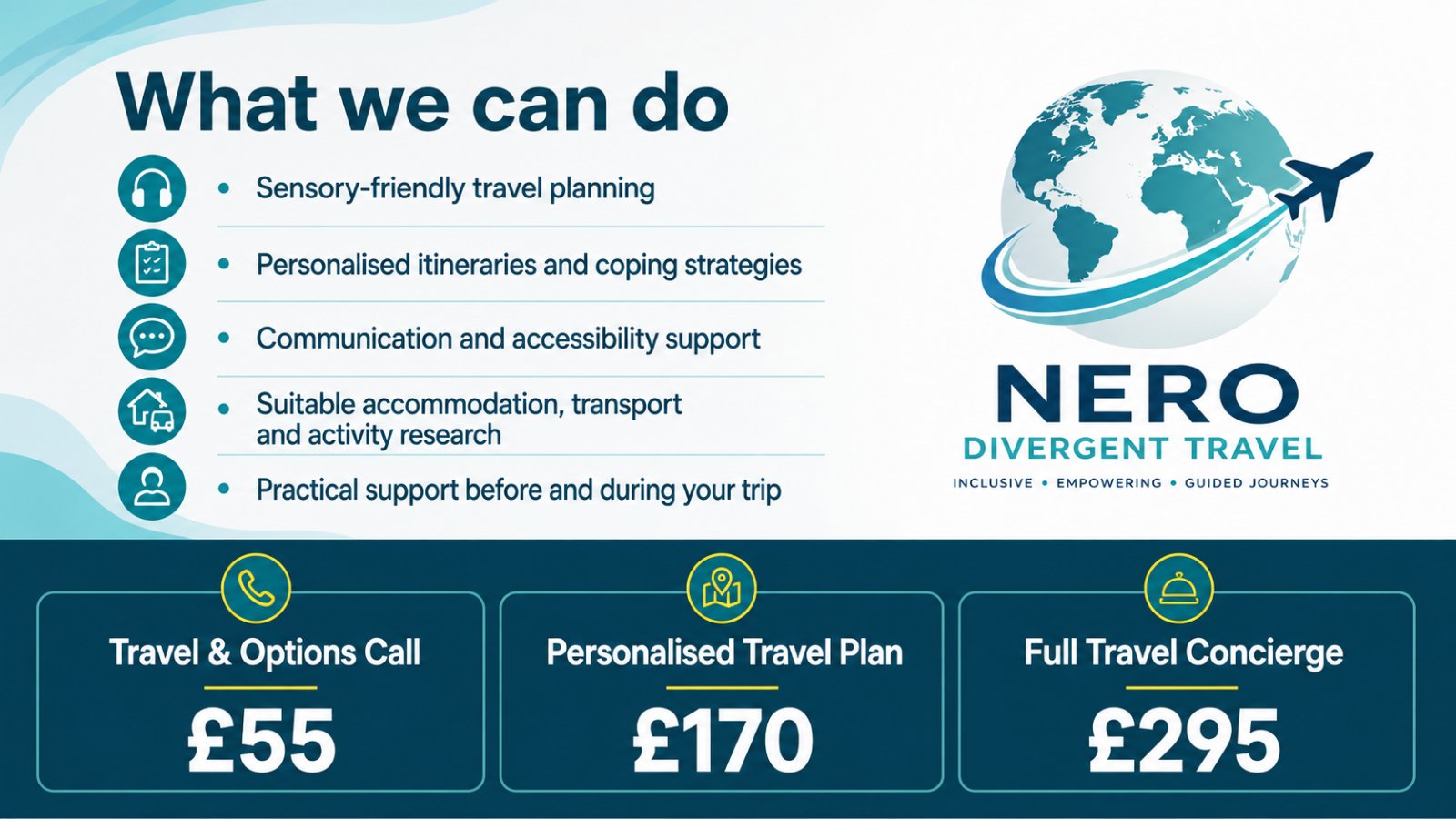
Everything about how I run Nero Divergent Travel comes back to this. Short calls instead of long ones. One decision at a time. Plans written in plain language. Zero judgement if you change your mind three times before we book anything, because I will absolutely have changed my mind three times too.
If the travel industry built more of its processes around brains like mine, I think a lot more people would get past “we keep talking about it” and actually book the holiday.
Questions and answers
Can someone with ADHD be a good travel planner?
Yes. Planning has always been how I cope, and I’ve also worked in the travel industry.
Why fewer choices?
The more options you give an overloaded brain, the less likely anything gets booked. One decision at a time works better.
Jemma Wild, Founder of Nero Divergent Travel — travel planning for neurodivergent individuals and families. nerodivergenttravel.com